
11 Best Software Solutions for Food and Beverage Supply Chains
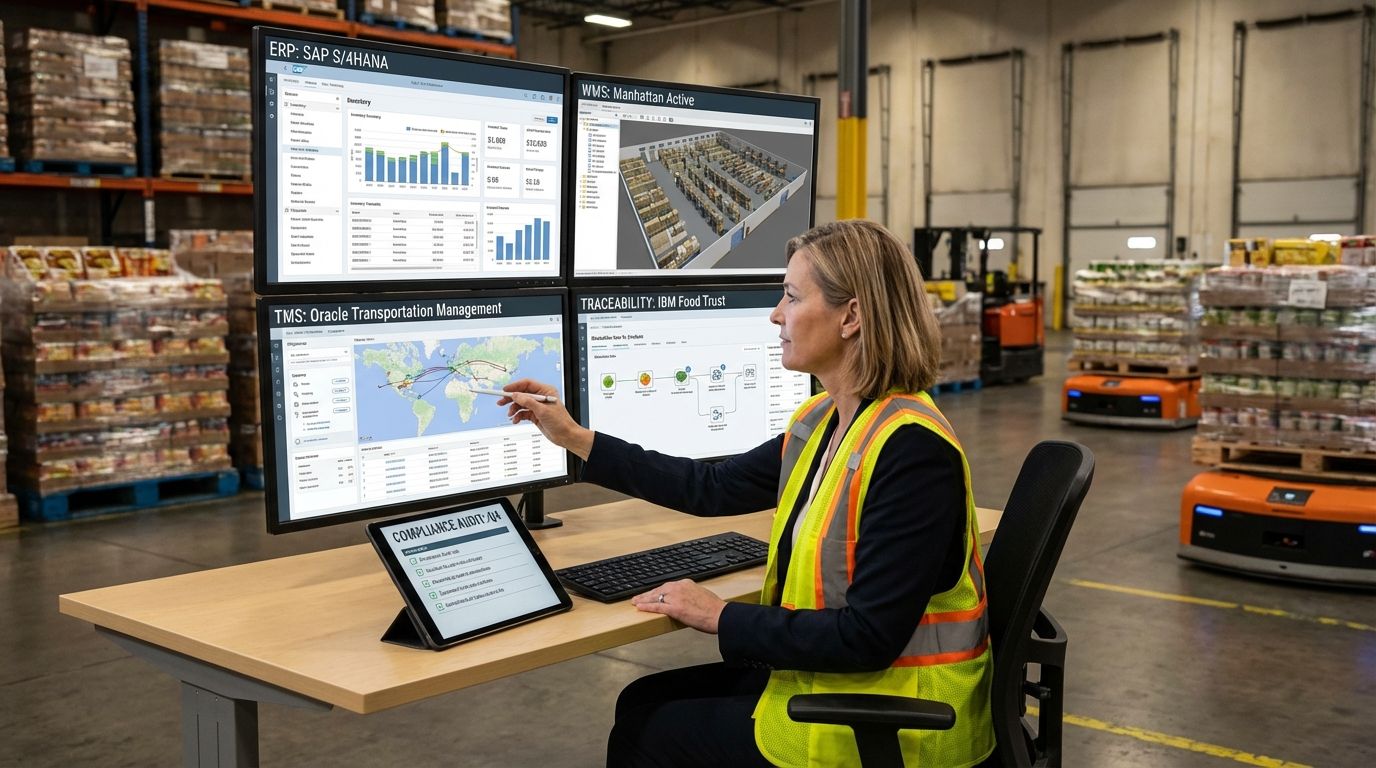
Table of Contents
- 1. Manhattan Associates: Manhattan Active Warehouse Management (WMS)
- 2. Blue Yonder: Warehouse Management (WMS)
- 3. SAP: Extended Warehouse Management (EWM) And Supply Chain Execution
- 4. Oracle: Oracle Warehouse Management (Fusion Cloud SCM)
- 5. Blue Yonder: Transportation Management (TMS)
- 6. Manhattan Associates: Manhattan Active Transportation Management (TMS)
- 7. Blue Yonder: Supply Chain Planning (Demand, Supply, And Inventory Planning)
- 8. SAP: ERP And Manufacturing Control For Food And Beverage
- 9. Oracle: ERP And Supply Chain Suite For Standardization At Scale
- 10. ReposiTrak: Traceability Network For FSMA 204 Data Sharing
- 11. IBM Food Trust: Multi-Party Traceability And Controlled Data Sharing
- How You Choose The Right Mix: Suite Versus Best-Of-Breed For Food And Beverage
- Implementation Rules That Keep You Out Of The “ERP Doesn’t Work” Trap
- Best Food And Beverage Supply Chain Software
- Build Your Shortlist, Then Validate It On The Warehouse Floor
Food and beverage supply chains run best when you standardize on a small set of execution and compliance systems: an ERP to control formula, cost, and inventory, a WMS to run FEFO and lot moves in the DC, a TMS to protect service and margin, and traceability tools that can answer a regulator or customer within hours, not days.
This list gives you eleven proven software options across those layers, plus practical guidance on where each one fits, what it solves in real operations, and what to validate before signing. You’ll leave with a clear short list you can take into demos, an implementation scorecard, and a way to avoid the common rollout mistakes that force teams back to spreadsheets.
1. Manhattan Associates: Manhattan Active Warehouse Management (WMS)
If warehouse complexity is high, Manhattan Active WM earns a hard look because it’s built to run dense picking, automation, and strict inventory controls without you inventing workarounds. In food distribution, the daily test is whether the system holds up when reality shows up: short dates, lot splits, repacks, quality holds, and last-minute order waves. Manhattan’s strength is that it’s designed for that kind of execution pressure, where RF speed and exception handling decide whether you ship on time.
You’ll want Manhattan on the table when the DC is your profit engine and the network can’t tolerate “close enough” inventory. FEFO discipline, lot genealogy, and task interleaving sound like features until the first recall simulation or a holiday surge exposes gaps. In selection, focus less on slideware and more on how quickly supervisors can re-prioritize work, how cleanly the system handles catch-weight adjustments, and how it reports “where the lot went” in a way you can hand to QA and customer teams.
Manhattan also tends to show up in Gartner Leader claims for WMS, which matters because it signals maturity at enterprise scale, not because the logo wins the project. Treat that positioning as a starting point, then confirm it against your exact operation: your automation controls, your voice picking or scanning style, your labeling, your yard and dock routines, and your returns or rework flows. If those don’t map cleanly, you’ll pay for it in customization and slower upgrades.
2. Blue Yonder: Warehouse Management (WMS)
Blue Yonder’s WMS belongs on the shortlist when you want warehouse execution that connects cleanly to broader supply chain planning and labor decisions. Food and beverage teams often get trapped in a false choice: optimize planning in the office or run fast execution on the floor. Blue Yonder’s pitch, and often its practical value, is tighter coordination between planning signals and warehouse execution, so the DC isn’t reacting blindly to demand swings and promotion spikes.
In a real F&B DC, the WMS must protect product integrity while maintaining throughput. That means lot control, date control, and temperature-sensitive handling can’t be “optional settings” that break under stress. During evaluation, push beyond standard receiving and picking and test the messy parts: mixed-SKU pallets, cross-dock decisions, short shipments, substitutions, and reallocation when a customer changes an order after it’s waved. If the system needs heavy admin intervention to do those moves, productivity slips and planners lose trust.
Blue Yonder also publicly states Leader placement in Gartner’s WMS coverage in recent cycles. Use that as a credibility marker, then validate what matters: configuration depth for food-specific constraints, ease of user adoption, and integration quality with your ERP, TMS, and traceability layer. A WMS can be “powerful” and still fail if floor teams can’t execute tasks quickly and consistently.
3. SAP: Extended Warehouse Management (EWM) And Supply Chain Execution
SAP EWM becomes compelling when your company already runs SAP for core ERP and you need warehouse execution that stays tightly aligned with finance, manufacturing, and quality. Food and beverage operations feel the pain of disconnects faster than most industries because expiry, holds, and rework drive constant inventory state changes. When ERP and WMS disagree, planners hedge, customer service overpromises, and the floor invents manual fixes that destroy traceability.
With SAP, the trade is straightforward: you gain standardization and a single operating model, and you accept a heavier governance requirement. SAP implementations succeed when master data discipline is non-negotiable: item attributes, batches, shelf life, storage conditions, and units of measure must be correct, maintained, and audited. If that discipline is weak, EWM will surface every flaw, and teams often mislabel the root cause as “the system.”
SAP has also publicly highlighted recognition as a Leader in Gartner’s WMS coverage. That matters most if you’re building for global scale or want a consistent template across many sites. During selection, keep the conversation grounded: confirm RF flows, slotting logic, quality inspection points, and how you’ll enforce FEFO in the face of customer-specific rules and partial pallets.
4. Oracle: Oracle Warehouse Management (Fusion Cloud SCM)
Oracle WMS is a strong candidate when you want cloud SCM that pairs warehouse control with broader Oracle supply chain capabilities. Many food and beverage teams choose Oracle when they’re modernizing multiple pieces at once: inventory, procurement, planning, and fulfillment. The key is to confirm that the WMS behavior matches your operational reality, not a generic distribution model.
In food and beverage, cloud WMS must do more than track a pallet. It must enforce date rules, manage holds, support relabeling and repack activity, and produce reliable lot genealogy. During demos, require a “day in the life” walk-through: receiving with lot capture, putaway based on temperature zone, wave planning under tight cutoffs, exception handling for shorts, and recall reporting with a clear audit trail. If any of those steps rely on external spreadsheets or custom code, risk increases.
Oracle has also publicly stated recognition as a Leader in Gartner’s Warehouse Management Systems coverage (notably in 2024 announcements). Treat that as a signal of market maturity, then evaluate how Oracle fits your integration reality: EDI flows, customer compliance labeling, carrier handoffs, and how you reconcile inventory and cost. In a regulated supply chain, “mostly integrated” behaves like “not integrated” the first time an audit hits.
5. Blue Yonder: Transportation Management (TMS)
Transportation is where food supply chains quietly lose margin: missed appointments, accessorial charges, empty miles, and service failures that turn into customer penalties. Blue Yonder’s TMS belongs on the list because it targets planning and execution at scale, where routing decisions, capacity constraints, and service commitments must stay aligned. If your network runs multi-stop routes, high shipment volumes, or tight delivery windows, a capable TMS protects performance while reducing manual dispatch work.
For refrigerated and time-sensitive shipments, the basics must be airtight: appointment scheduling, carrier compliance checks, tendering, tracking, and exception resolution. You also need strong cost controls: auditing accessorials, controlling mode selection, and measuring carrier scorecards with consistent data. In selection, press on visibility and exception workflows, because that’s where teams either stay proactive or get stuck reacting to “where’s my load” calls all day.
Blue Yonder has publicly stated Leader recognition in Gartner’s Transportation Management Systems coverage in 2025 announcements. Use that as validation that the product competes at enterprise scale, then confirm fit in your environment: integrations to warehouse shipping, customer portals, EDI/API connectivity with carriers, and how well the system supports private fleet, brokerage, or 3PL models if those apply.
6. Manhattan Associates: Manhattan Active Transportation Management (TMS)
Manhattan’s TMS is a strong option when you want transportation execution that stays tightly coordinated with warehouse activity, order release, and customer service. Food and beverage networks struggle when the DC is optimized for internal efficiency but transportation is optimized separately, or not optimized at all. That split shows up as late departures, missed delivery slots, and load plans that don’t match what the warehouse can actually stage.
When the warehouse and transport systems cooperate, you get measurable gains: fewer short loads, better cube utilization, cleaner appointment adherence, and faster exception resolution. Your evaluation should stress how the TMS handles real constraints: store delivery windows, route density, temperature-controlled requirements, driver hours, and dock congestion. A TMS that can’t manage constraints forces dispatchers back into manual decisions, and those decisions rarely scale.
Manhattan has publicly stated repeated Gartner Magic Quadrant Leader recognition for TMS in 2025 announcements. That supports its credibility in transportation, especially for companies that already run Manhattan in the DC. Confirm whether you want a unified execution platform or a best-of-breed transport stack, then score integration effort honestly, not optimistically.
7. Blue Yonder: Supply Chain Planning (Demand, Supply, And Inventory Planning)
Planning tools matter in food and beverage because shelf life turns forecasting errors into scrapped product, expedited freight, and service failures. Blue Yonder’s planning suite is relevant when you need stronger demand signals, inventory policy control, and supply planning that reflects real constraints. The goal isn’t prettier forecasts, it’s tighter coordination between demand plans, production schedules, and DC replenishment so you stop oscillating between stockouts and waste.
In food operations, planning must be date-aware and constraint-aware. You need policies that respect shelf-life targets, customer freshness requirements, and batch size constraints in manufacturing. That requires clean master data and disciplined parameter management, or planners will override outputs and the tool turns into an expensive reporting layer. During evaluation, ask how planners will manage promotions, seasonality, and substitutions, and how the system measures forecast bias and service impact with accountability.
Blue Yonder has publicly stated Leader recognition in Gartner’s Supply Chain Planning coverage in 2025 announcements. That gives you confidence the tooling is competitive, but the bigger determinant is governance: who owns the forecast, how you reconcile sales inputs with statistical models, and how you lock and release plans to execution teams. If those decisions are unclear, no planning platform will deliver reliable results.
8. SAP: ERP And Manufacturing Control For Food And Beverage
ERP is the backbone for recipe management, batch production, costing, procurement, quality, and financial control. SAP is a common enterprise choice because it can standardize operations across plants, co-manufacturers, and distribution networks. In food and beverage, success depends on whether ERP reflects process manufacturing realities: variable yields, catch weight, packaging changes, quality release, and inventory state transitions that happen daily.
ERP selection and rollout often fail for predictable reasons: excessive customization, weak master data ownership, unclear process governance, and underfunded training. When those issues exist, users blame the tool and rebuild work in spreadsheets, which destroys traceability and audit readiness. During selection, insist on clear process templates and a disciplined change-control approach. ERP must enforce standards, not document exceptions after the fact.
In operational terms, evaluate SAP on how it manages batch genealogy, quality inspection points, and recall reporting without heroic manual effort. Confirm how it integrates with WMS, TMS, and traceability networks, and how it handles external trading partner data. ERP is not a “set it and forget it” system in food; it’s a control system that must be maintained like one.
9. Oracle: ERP And Supply Chain Suite For Standardization At Scale
Oracle’s ERP and broader SCM suite can fit well when you want a cloud-first model and consistent workflows across procurement, inventory, and fulfillment. Food and beverage operations that grow through acquisitions often need a faster path to standardization than legacy on-prem models can deliver. Oracle is often evaluated in that scenario because it can support enterprise controls without requiring every site to run a different local system.
During evaluation, focus on the operational friction points that usually break standardization: units of measure, lot capture rules, shelf life configuration, customer-specific labeling, and chargeback workflows. If these details are mishandled, execution teams lose trust and adopt side systems, which defeats the core reason to run a unified suite. Oracle can support strong controls, but only if you enforce consistent process definitions and data ownership from day one.
Also validate integration behavior under pressure. Confirm how Oracle exchanges data with shop floor systems, automation, EDI trading partners, carriers, and compliance networks. In food and beverage, data latency and mismatched identifiers are not minor annoyances, they become recall risk and customer service risk.
10. ReposiTrak: Traceability Network For FSMA 204 Data Sharing
When FSMA 204 readiness becomes a board-level priority, traceability stops being a “QA system” and becomes a supply chain system. ReposiTrak is positioned as a network-based approach that helps suppliers, wholesalers, and retailers exchange FDA-required Key Data Elements across trading partners. The practical value is that it targets the hard part of traceability: partner onboarding, data exchange, and consistent record sharing across companies that do not run the same internal systems.
ReposiTrak announced in October 2024 that its traceability network reached 4,000 suppliers, framing that growth around easier onboarding and data sharing for FSMA 204 preparation. That kind of network scale matters if your operation depends on many suppliers and customers, because you don’t want to build a one-off integration for every partner. During evaluation, confirm what data is required from you, what data you can pass through, and how exceptions are handled when suppliers provide incomplete or inconsistent KDEs.
Timing also matters. The FDA’s Food Traceability Rule originally carried a compliance date of January 20, 2026, and the FDA has also described a proposed 30-month extension to July 20, 2028, with Congressional direction not to enforce before July 20, 2028. That runway should change how you plan: focus on data quality, internal lot discipline, and partner connectivity now, then scale automation and reporting workflows with measured milestones rather than a rushed, last-minute purchase.
11. IBM Food Trust: Multi-Party Traceability And Controlled Data Sharing
IBM Food Trust is relevant when traceability requires multi-party collaboration and controlled data access across a network. In regulated food supply chains, the trace problem is rarely “can the company trace internally,” it’s “can the company trace through suppliers and customers quickly, with consistent identifiers, and with clear permissions.” IBM Food Trust documentation describes trace workflows that rely on product identifiers like lot numbers, purchase order numbers, and facility IDs, and it emphasizes that data owners control access through policies and permissions.
That matters when your supply chain includes co-manufacturers, re-packers, distributors, and retailers who each maintain separate systems and separate incentives. During selection, validate how quickly your team can locate a lot, trace events, narrow results by date range or event type, and export outputs in a format QA and compliance teams can use. Also confirm how access control works in practice, because partners will not share data broadly unless permissions are clear and enforceable.
IBM Food Trust tends to fit best when the business wants traceability as a shared operational capability, not a compliance report run once a quarter. If recall drills are slow or error-prone today, a network tool can help, but only if internal master data and receiving/shipping discipline are already stable. Network trace cannot fix broken internal lot capture.
How You Choose The Right Mix: Suite Versus Best-Of-Breed For Food And Beverage
Selection becomes simpler when you stop searching for a single “perfect platform” and start matching tools to operational choke points. If manufacturing control, finance, and standardized processes are the main priority, a suite-driven path with SAP or Oracle often fits better. If warehouse throughput and exception handling drive customer performance, best-of-breed WMS often delivers stronger execution than an ERP-anchored warehouse module, depending on your use case.
Integration risk is real, but it can be managed if you design around clean ownership of master data and transaction boundaries. Define which system owns item attributes, lot creation, quality status, inventory balances, shipment creation, and freight settlement. When ownership is fuzzy, teams chase discrepancies and the business pays twice: once for software, then again for labor to reconcile data.
Traceability is the non-negotiable layer that ties the whole stack together. Internal lot discipline must exist in ERP and WMS, and partner data exchange must exist outside those systems if your trading partners won’t adopt your tools. The best selection outcome is a stack that produces fast, defensible recall answers without your team spending days assembling data from multiple exports.
Implementation Rules That Keep You Out Of The “ERP Doesn’t Work” Trap
Software rarely fails in food and beverage because the vendor forgot a feature. It fails because implementations treat operational data and training as secondary workstreams. If item masters, units of measure, shelf life rules, lot capture, storage zones, and label specs are incomplete, the system will output incorrect inventory and unreliable planning signals. Teams then compensate manually, and the “system of record” stops being the record.
Training must be designed for how people actually work. Floor users need RF flows that match physical movement, supervisors need exception tools they can run in minutes, and planners need parameters they can govern without constant IT help. If the rollout plan assumes users will “learn on the job,” productivity will drop and leadership will accept workarounds to restore service, locking in bad habits for years.
Hold the line on customization. Food and beverage businesses often have long-standing local practices that feel necessary but are not scalable. Configure the system to enforce standards, then change processes where the standard is better. Customization can be justified for competitive advantage, not for preserving habits that create audit risk or prevent upgrades.
Best Food And Beverage Supply Chain Software
- ERP: SAP, Oracle
- WMS: Manhattan Active WM, Blue Yonder WMS, SAP EWM, Oracle WMS
- TMS: Blue Yonder TMS, Manhattan Active TM
- Traceability: ReposiTrak, IBM Food Trust
Build Your Shortlist, Then Validate It On The Warehouse Floor
The best software choices are the ones that match your operational pressure points: warehouse execution, transportation control, planning discipline, and traceability speed. A credible shortlist for 2026 combines enterprise execution platforms like Manhattan, Blue Yonder, SAP, and Oracle with purpose-built traceability networks like ReposiTrak and IBM Food Trust. Regulatory timing for FSMA 204 should shape priorities, using the runway to clean master data, stabilize lot discipline, and onboard partners instead of rushing into brittle integrations. Once the shortlist is set, run demos against real workflows: FEFO picking, QC holds, repacks, appointment constraints, and recall drills. If the software performs under those conditions, the business will stop firefighting and start managing by exception with confidence.
Related Posts

How to Build a Business Case for a New Supply Chain Software
Learn how to build a supply chain software business case with...

Your Warehouse Workers Are Your Biggest Untapped Asset
Treat warehouse workers as a business asset to improve accuracy, safety,...

7 Best Software Solutions for Cold Chain Compliance and Safety
Discover the 7 best cold chain software solutions for compliance, temperature...

The Data Your TMS Provides Is Probably Wrong. Here’s Why.
TMS data accuracy issues can distort ETA, cost, and service reporting....