
3D Printing Revolution: On-Demand Manufacturing Disrupting Supply Chains
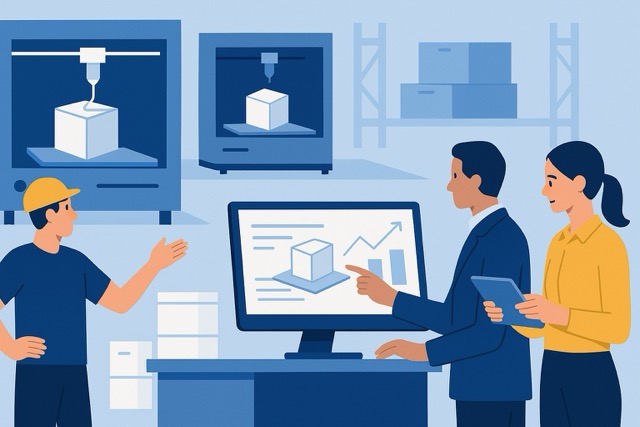
Table of Contents
- From Bulk Inventory to Digital Warehousing
- Speeding Up Product Development Cycles
- Unlocking Hyper-Customization
- Localizing Production for Faster Response
- Raising Resilience Without Raising Costs
- Reducing Environmental Impact
- Adapting to Current Limitations
- How Is 3D Printing Changing Supply Chains?
- In Conclusion
If you’re operating in the supply chain space, you’ve likely faced the pressure of balancing efficiency with agility—minimizing inventory, speeding up delivery, and staying resilient through global disruption. 3D printing, also known as additive manufacturing, offers a direct response to those pressures. By letting you produce components and finished goods on demand, closer to the point of use, it’s not just changing how you manufacture—it’s shifting the structure of entire supply chains. This article unpacks how 3D printing can help you streamline operations, reduce risk, and future-proof your network in ways that traditional manufacturing simply can’t match.
From Bulk Inventory to Digital Warehousing
You’re probably familiar with the overhead of maintaining stock—storage, depreciation, and capital tied up in safety stock. 3D printing lets you rethink that approach. Instead of holding finished goods in warehouses, you hold digital files and raw material stock. When demand hits, you produce the item immediately, in the quantity needed, often in the same location where it’s needed.
This “just-in-time” model reduces the need for massive storage facilities and lets you avoid the cost of overproduction. For spare parts, especially slow-moving ones, this is a game changer. Aerospace and heavy equipment manufacturers are already shifting to digital inventories, slashing long-tail inventory costs while maintaining service levels.
Speeding Up Product Development Cycles
Time-to-market is critical when you’re launching a new product. Traditional prototyping can take weeks, involving third-party tooling, shipping delays, and costly revisions. With a 3D printer in-house, your design team can iterate in hours, test functionality immediately, and refine before it ever leaves the lab.
You’re not just accelerating prototyping—you’re de-risking the entire launch. That flexibility also allows you to respond quickly to changes in customer demand, regulatory requirements, or supply constraints. You can launch niche SKUs without committing to massive runs, which opens the door to market testing without high exposure.
Unlocking Hyper-Customization
If your customers want personalized parts, custom-fit products, or localized branding, traditional manufacturing can get expensive fast. 3D printing makes one-off customization cost-effective. You don’t need new molds or retooled lines—you just adjust the digital file.
In consumer goods, this lets you offer differentiated value. In healthcare and automotive, it allows patient-specific implants or driver-specific modifications. The flexibility here isn’t just operational—it’s strategic. You’re able to deliver unique experiences without adding complexity to your production planning.
Localizing Production for Faster Response
One of the strongest supply chain advantages of 3D printing is the ability to shift production closer to demand. You no longer have to depend on centralized plants or cross-border shipments for every unit. With a distributed network of 3D printers—either in your own facilities or through partners—you can fulfill orders locally and reduce transit time and cost.
This is especially useful in remote markets or in scenarios where supply chain risk is high. During major disruptions like natural disasters or trade restrictions, this localized model offers continuity. You’re not waiting on a container ship—you’re running a print job.
Raising Resilience Without Raising Costs
Supply chain resilience used to mean building redundancy—more suppliers, more safety stock, more warehouse locations. All of that adds cost. 3D printing gives you resilience without the same financial load. With fewer dependencies on molds, tooling, or minimum order quantities, you can pivot faster when conditions change.
You can also insulate yourself from supplier outages. If one facility is down, the file can be sent to another location in seconds. This digital flexibility helps you avoid bottlenecks while maintaining cost control. That’s a major advantage when you’re navigating unpredictable global markets.
Reducing Environmental Impact
You’ve probably been asked to make your operations more sustainable—whether by regulators, investors, or customers. 3D printing supports those goals by minimizing material waste, reducing the need for long-haul transportation, and enabling small-batch production that aligns with actual demand.
In sectors like fashion and consumer goods, on-demand printing means you’re not overproducing seasonal inventory that ends up marked down or discarded. In industrial applications, you’re reducing machining waste and optimizing material usage layer by layer. All of this adds up to lower emissions, less scrap, and a smaller environmental footprint.
Adapting to Current Limitations
While 3D printing has come a long way, it’s not a fit for everything—yet. Print speed for high-volume runs, material selection, and part consistency still limit its application for certain products. But those limitations are narrowing fast. Metal additive manufacturing is now used in aerospace and medical implants, while new polymers are expanding consumer applications.
The key is to start with use cases where 3D printing gives you a clear edge—customization, spare parts, low-volume runs—and build from there. You don’t need to overhaul your entire production model. You just need to know where this technology helps you outperform your competitors.
How Is 3D Printing Changing Supply Chains?
- Enables local, on-demand production
- Reduces inventory and storage costs
- Speeds up product development
- Supports customization at scale
- Enhances supply chain resilience and flexibility
In Conclusion
3D printing isn’t just a tool—it’s a supply chain strategy. It gives you the ability to respond faster, customize more, and operate leaner. Whether you’re reducing inventory exposure, launching products quicker, or localizing fulfillment, additive manufacturing gives you options that traditional models can’t match. The more you integrate 3D printing into your supply chain strategy, the more agile, sustainable, and competitive you become. And as the technology continues to advance, the companies that adopt early will be the ones setting the pace, not chasing it.
For more content on technology, industry trends, and my perspectives, please visit my SoundCloud profile
Related Posts

How to Build a Business Case for a New Supply Chain Software
Learn how to build a supply chain software business case with...
Your Warehouse Workers Are Your Biggest Untapped Asset
Treat warehouse workers as a business asset to improve accuracy, safety,...

7 Best Software Solutions for Cold Chain Compliance and Safety
Discover the 7 best cold chain software solutions for compliance, temperature...

The Data Your TMS Provides Is Probably Wrong. Here’s Why.
TMS data accuracy issues can distort ETA, cost, and service reporting....