
Automation in Warehousing: Robots, Cobots, and the Future of Work
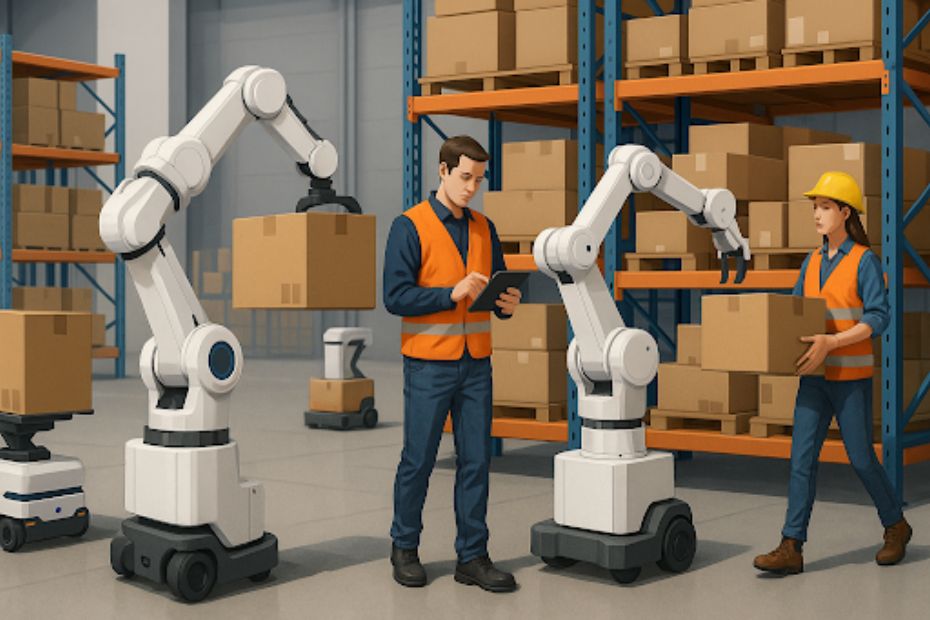
Table of Contents
- Robots That Keep the Work Moving
- Cobots That Work With, Not Instead Of, People
- Filling Labor Gaps Without Burning Out Staff
- Safer Warehouses Built on Shared Responsibility
- Fewer Errors, Faster Fulfillment
- Scaling Operations Without Growing Headaches
- The Future Is Smarter—With AI in the Driver’s Seat
- How Robots and Cobots Are Changing Warehousing
- In Conclusion
If you’re overseeing warehouse operations, you’ve probably noticed the shift happening around you. What used to be a space powered solely by human labor is now filled with autonomous mobile robots, collaborative machines, and intelligent systems that never take a break. Automation in warehousing isn’t about replacing jobs—it’s about upgrading how work gets done. Robots and cobots are solving staffing gaps, reducing injury rates, and making your facility more efficient without sacrificing flexibility. In this article, you’ll see exactly how automation tools are being used today and what they mean for the future of your workforce and supply chain operations.
Robots That Keep the Work Moving
When you’re managing thousands of SKUs across a massive facility, getting products from one point to another quickly and accurately is a constant challenge. Robots designed for warehouse automation—especially autonomous mobile robots (AMRs)—take that task off your team’s plate. These machines navigate warehouse aisles independently, picking, sorting, or transporting goods without bumping into people or shelves.
You’re not locking into a rigid system either. Unlike fixed conveyors or legacy automation, modern robots can be reprogrammed and redeployed based on current needs. That kind of flexibility lets you respond to spikes in demand without hiring dozens of temporary workers or reconfiguring your layout.
Cobots That Work With, Not Instead Of, People
If the word “robot” makes your team nervous, show them a cobot in action. These collaborative robots are designed to work side by side with your staff—not replace them. Cobots are lightweight, safe to operate without cages, and often take on tasks that are repetitive or physically exhausting.
Let’s say you’ve got a worker picking items from low bins all day. A cobot can handle the bending and lifting while your team member focuses on organizing and scanning. That reduces fatigue and the risk of injury. In more advanced applications, cobots can assist with packaging, labeling, and even machine tending—all while staying responsive to nearby human activity.
Filling Labor Gaps Without Burning Out Staff
Warehouse labor is hard to find and even harder to retain. You know how quickly absenteeism or high turnover can throw off productivity. Robots don’t call in sick or quit mid-shift. That doesn’t mean replacing people—it means stabilizing your operation so your team can focus on higher-value tasks that actually need a human touch.
You get consistent performance from automation, and your workers get relief from the parts of the job that wear them out. It’s a win-win. Plus, you can train your team to supervise, program, or maintain robotic systems—giving them a path toward more skilled, better-paying roles inside your operation.
Safer Warehouses Built on Shared Responsibility
Injury risk is a major concern in warehousing, especially with heavy lifting, long hours, and tight schedules. When you bring in automation, you reduce those risks immediately. A robot doesn’t get tired, and it doesn’t take shortcuts that could lead to accidents. You can offload repetitive strain tasks—like palletizing, unloading, or long-haul picking—to machines that are designed to handle them with precision.
Cobots make this even safer because they’re equipped with collision detection and safety sensors. If a human steps too close, the cobot pauses or adjusts its movement. That kind of adaptability helps you avoid downtime due to injury and creates a safer work culture overall.
Fewer Errors, Faster Fulfillment
Speed and accuracy don’t always go hand in hand—unless you’re using automation. Robots equipped with machine vision and barcode scanners can pick and place with incredible precision. They don’t mix up items, they don’t mislabel packages, and they don’t forget what’s on the pick list halfway through a batch.
This accuracy leads to fewer returns and better customer reviews, especially in e-commerce environments where expectations are sky-high. And because robots can work continuously across multiple shifts, you meet higher demand without sacrificing quality.
Scaling Operations Without Growing Headaches
You’ve probably seen how unpredictable peak season gets. Hiring and training dozens of temp workers for a few months is expensive—and risky. With warehouse robots and cobots, scaling becomes much simpler. You can deploy additional machines during busy periods and scale them back during slower months without worrying about recruiting or onboarding.
You can also reprogram existing bots to take on new routes, workflows, or stations as your product mix changes. That flexibility means you won’t need to redesign your floor plan every time you grow. It keeps your operation agile and your overhead in check.
The Future Is Smarter—With AI in the Driver’s Seat
The next generation of automation isn’t just reactive—it’s predictive. Machine learning and AI are now being built into warehouse automation systems to help your bots get smarter over time. These tools learn from every route, every scan, and every error, so they can optimize paths, avoid congestion, and even anticipate maintenance issues before they cause downtime.
That means your robots and cobots aren’t just executing commands—they’re helping you run a smarter facility. You get predictive analytics, real-time monitoring, and self-adjusting workflows that make your warehouse more efficient without extra headcount.
How Robots and Cobots Are Changing Warehousing
- Automate repetitive picking, packing, and sorting tasks
- Work safely alongside human workers to reduce strain
- Fill labor shortages without sacrificing performance
- Cut injuries by handling heavy or risky operations
- Improve order accuracy and fulfillment speed
- Scale quickly with reprogrammable automation
- Use AI to optimize operations over time
In Conclusion
When you bring automation into your warehouse, you’re not replacing people—you’re equipping your team with better tools. Robots and cobots take care of the heavy lifting, the high-speed sorting, and the tasks that slow you down or put your workers at risk. Your operation becomes faster, safer, and more consistent. And your people get the chance to move into roles that focus on planning, oversight, and improvement. If you’re looking for a way to meet rising demand without burning out your staff or bloating your payroll, warehouse automation isn’t just an option—it’s your next competitive edge.
Want more insights on how tech is transforming supply chain operations? Follow Benjamin Gordon‘s latest articles and updates.
Related Posts

How to Build a Business Case for a New Supply Chain Software
Learn how to build a supply chain software business case with...
Your Warehouse Workers Are Your Biggest Untapped Asset
Treat warehouse workers as a business asset to improve accuracy, safety,...

7 Best Software Solutions for Cold Chain Compliance and Safety
Discover the 7 best cold chain software solutions for compliance, temperature...

The Data Your TMS Provides Is Probably Wrong. Here’s Why.
TMS data accuracy issues can distort ETA, cost, and service reporting....