
Top 5 Digital Twin Platforms for Supply Chain Modeling
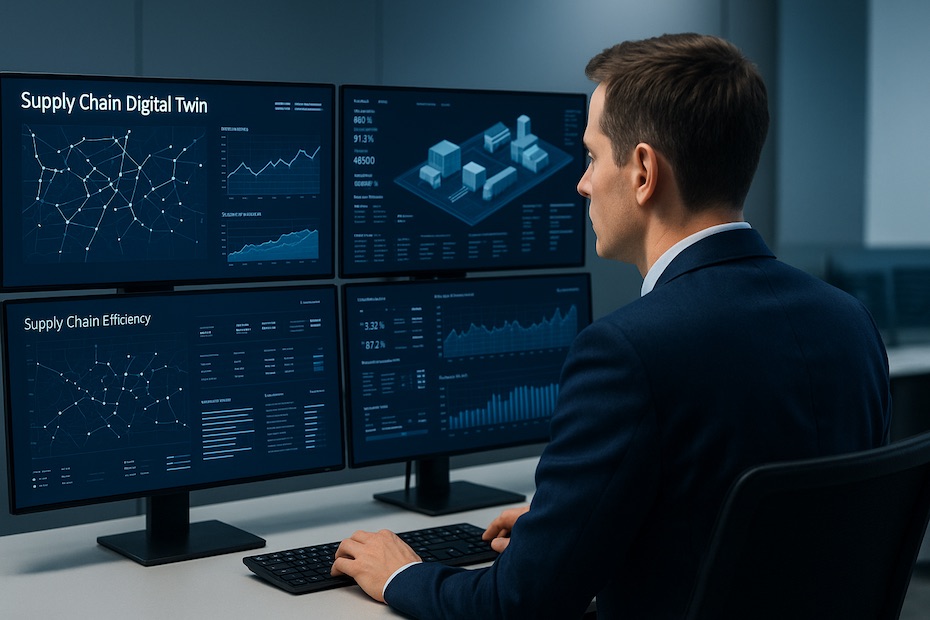
Table of Contents
- Platform 1: AnyLogistix (ALX) — Simulation-Driven Supply Chain Excellence
- Platform 2: Coupa Supply Chain Design & Planning — Enterprise-Level Decision Intelligence
- Platform 3: Dassault Systèmes 3DEXPERIENCE / DELMIA — Virtual Twin for Complex Networks
- Platform 4: Siemens Logistics Digital Twin — Precision in Facility and Network Modeling
- Platform 5: ParkourSC — Real-Time Visibility Across the Extended Supply Chain
- How to Choose the Right Digital Twin Platform
- Implementation Strategy: From Pilot to Full-Scale Deployment
- Common Use Cases and Measurable Outcomes
- Best digital twin platforms for supply chain modeling
- Prepare Your Supply Chain for the Next Era of Intelligence
The best digital twin platforms for supply chain modeling help you visualize, simulate, and optimize every layer of your logistics network in real time. These tools integrate data from across your operations—production, warehousing, transportation, and suppliers—to forecast risks, improve decisions, and maximize performance.
In this article, you’ll explore five leading platforms driving innovation in digital supply chain design. You’ll also understand how to evaluate these systems, apply them strategically, and scale their use to achieve measurable cost savings and resilience in your logistics network.
Platform 1: AnyLogistix (ALX) — Simulation-Driven Supply Chain Excellence
AnyLogistix (ALX) stands out for its simulation-first approach, designed to model end-to-end supply chains with precision. Built on the AnyLogic simulation engine, ALX allows you to experiment with different network configurations, inventory strategies, and transport routes without disrupting real-world operations.
You can combine discrete event and agent-based modeling to understand how your logistics network responds to variable demand, supply shocks, or capacity changes. The platform also integrates with ERP and WMS systems, letting you pull live data for real-time scenario testing.
Companies use ALX to conduct “what-if” analyses—such as testing how weather or port congestion impacts delivery schedules. By simulating thousands of scenarios, you can determine optimal configurations before making multimillion-dollar decisions.
For businesses managing complex global operations, AnyLogistix offers unmatched depth in modeling and performance testing.
Platform 2: Coupa Supply Chain Design & Planning — Enterprise-Level Decision Intelligence
Coupa, which evolved from the LLamasoft acquisition, provides one of the most advanced AI-driven digital twin solutions for supply chain modeling. Its platform is built for large-scale enterprises aiming to connect procurement, finance, and logistics functions within one ecosystem.
You can use Coupa’s digital twin to simulate sourcing, transportation, and inventory decisions. The platform automatically analyzes trade-offs between cost, service, and risk, enabling faster and more confident decisions. For instance, manufacturers use it to evaluate alternate supplier networks or reroute distribution under geopolitical disruptions.
Coupa’s cloud-native design allows seamless collaboration between planners, finance teams, and logistics managers. Its AI-powered demand forecasting and network optimization tools provide actionable insights with measurable ROI.
For executives managing multinational operations, Coupa delivers both strategic simulation and real-time decision orchestration, making it a strong fit for enterprise deployment.
Platform 3: Dassault Systèmes 3DEXPERIENCE / DELMIA — Virtual Twin for Complex Networks
Dassault Systèmes’ 3DEXPERIENCE platform, powered by DELMIA, offers an immersive virtual twin environment for complex supply chains that require 3D visualization and advanced simulation. It bridges digital modeling with physical execution—ideal for industries like automotive, aerospace, and advanced manufacturing.
Using the DELMIA module, you can visualize every process—from supplier sourcing to final delivery—on a unified digital map. The platform’s strength lies in its ability to connect engineering, manufacturing, and logistics operations under one digital model.
You can evaluate material flow, capacity, and energy consumption while simulating “what-if” scenarios to balance production and transportation trade-offs. Dassault’s virtual twin approach doesn’t just simulate performance—it links design and execution in real time, aligning with sustainability goals and ESG metrics.
If your supply chain depends on synchronized production and logistics planning, Dassault Systèmes offers the most comprehensive virtual twin environment in the market.
Platform 4: Siemens Logistics Digital Twin — Precision in Facility and Network Modeling
Siemens’ Logistics Digital Twin is built for operations that demand precision in warehouse, yard, and transportation management. Unlike general-purpose simulation tools, Siemens specializes in modeling logistics infrastructure, allowing you to experiment with facility layouts, automation systems, and flow optimization.
You can map physical and digital assets—conveyor belts, vehicles, loading docks—and simulate workflows before implementation. With AI-powered predictive control, the system anticipates bottlenecks and adjusts operations automatically to maintain throughput efficiency.
One global distribution company using Siemens’ digital twin reconfigured its dock scheduling system based on simulation outputs, cutting idle time by 20% and reducing shipping delays by 12%.
If your logistics strategy relies heavily on warehouse automation or facility optimization, Siemens delivers measurable efficiency gains through predictive and prescriptive modeling.
Platform 5: ParkourSC — Real-Time Visibility Across the Extended Supply Chain
ParkourSC (formerly Cloudleaf) focuses on real-time digital twins that track assets, shipments, and partners across multi-tier networks. Unlike design-focused platforms, ParkourSC operates at the execution layer—giving you continuous visibility into logistics and fulfillment performance.
You can use the platform’s sensor-driven digital twin to monitor shipment conditions, transit times, and location updates across global networks. AI algorithms then predict potential disruptions—temperature deviations, route delays, or supplier bottlenecks—and recommend preventive actions.
Enterprises in pharmaceuticals, food logistics, and high-value electronics depend on ParkourSC for temperature-controlled and time-sensitive supply chains. Its IoT integration and decision automation make it ideal for managing perishable or regulated goods.
For supply chains that require live monitoring and agility, ParkourSC turns complex networks into manageable digital ecosystems.
How to Choose the Right Digital Twin Platform
Selecting the right platform depends on your organization’s maturity, budget, and objectives. While all five platforms excel in modeling and optimization, their focus areas differ.
- AnyLogistix (ALX) — Ideal for simulation-heavy analysis and academic/enterprise modeling.
- Coupa — Best for strategic planning and financial alignment.
- Dassault Systèmes — Designed for manufacturing ecosystems with deep 3D visualization needs.
- Siemens — Optimized for facility and process simulation.
- ParkourSC — Focused on real-time operational visibility and predictive control.
When evaluating, prioritize:
- Integration with your existing ERP and analytics stack.
- Scalability across regions and partners.
- Ease of model updates and collaboration features.
- Support for AI and predictive analytics.
Implementation Strategy: From Pilot to Full-Scale Deployment
To implement a digital twin platform effectively, start small. Choose a high-impact pilot area—such as a single distribution network or product line—and model its real-world data in your selected platform.
As the model stabilizes, expand the scope to include suppliers, transport partners, and customer demand patterns. Ensure that data quality and consistency are maintained across all nodes.
You should also set measurable KPIs before deployment—inventory turnover, service level improvement, and cost reduction. Regularly monitor outcomes and feed real-world results back into the model for iterative refinement.
Step-by-step rollout sequence:
- Define use case and success metrics.
- Integrate ERP, IoT, and logistics data sources.
- Develop and validate a pilot twin.
- Conduct “what-if” scenario tests.
- Train planners and decision-makers.
- Scale deployment across the full network.
Common Use Cases and Measurable Outcomes
Digital twin platforms are now a proven enabler of measurable gains in logistics performance. You can apply them to:
- Network optimization: Reducing transport costs and improving delivery speed.
- Inventory management: Forecasting stock needs with precision.
- Sustainability tracking: Simulating carbon and energy footprints.
- Risk management: Predicting disruptions and modeling contingencies.
- Capacity planning: Testing expansion scenarios without costly trial runs.
Companies using supply chain digital twins report quantifiable results, including:
- 20–40% reduction in inventory holding costs.
- 10–15% improvement in on-time delivery rates.
- 25% shorter response time to supply disruptions.
Best digital twin platforms for supply chain modeling
- AnyLogistix (ALX)
- Coupa Supply Chain Design & Planning
- Dassault Systèmes 3DEXPERIENCE
- Siemens Logistics Digital Twin
- ParkourSC
Prepare Your Supply Chain for the Next Era of Intelligence
As global logistics grows more complex, relying on static models or spreadsheets is no longer enough. By integrating digital twin technology, you move from reactive management to predictive control—transforming visibility, cost efficiency, and resilience.
Whether you’re optimizing a single facility or a global network, adopting the right digital twin platform equips your team with the data-driven agility that defines tomorrow’s logistics leaders.
If you want deeper insights into digital twin use cases, technology comparisons, and supply chain innovation trends, visit my profile to explore more of my posts.
Related Posts

How to Build a Business Case for a New Supply Chain Software
Learn how to build a supply chain software business case with...

Your Warehouse Workers Are Your Biggest Untapped Asset
Treat warehouse workers as a business asset to improve accuracy, safety,...

7 Best Software Solutions for Cold Chain Compliance and Safety
Discover the 7 best cold chain software solutions for compliance, temperature...
The Data Your TMS Provides Is Probably Wrong. Here’s Why.
TMS data accuracy issues can distort ETA, cost, and service reporting....